
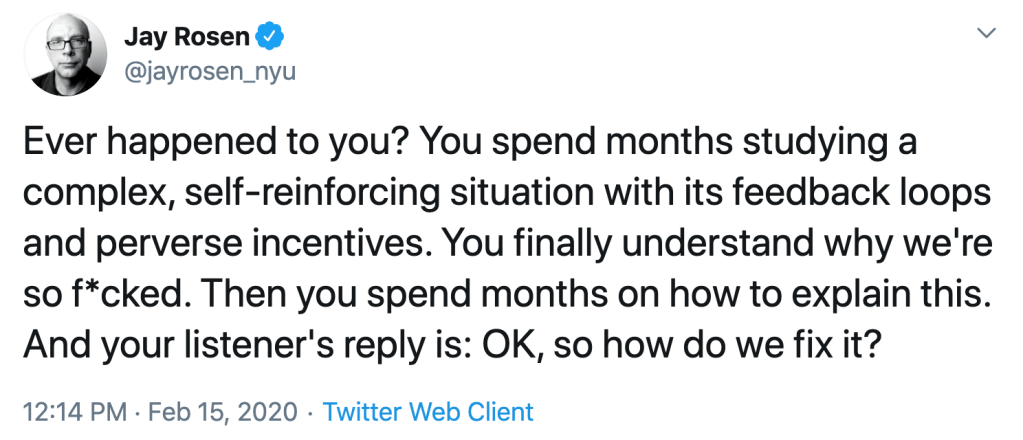
Today Jay Rosen describes and asks about the perversely self-reinforcing system that is threatening us all:
This reminds me of Vaclav Havel’s central essay, “The Power of the Powerless,” which is sometimes reprinted in a longer book by the same name. (Not sure, but I think I recall that Jay Rosen is an admirer of Havel.) The essay was circulated in spite of the censorship of the Eastern Bloc just a few years before the seemingly impossible, breath-taking collapse of the Soviet empire there.
Through the middle parts of this long essay, Havel details the self-reinforcing corruption of every institution in Soviet-dominated Czechoslovakia. For example, in section 17 he says that the legal system sometimes creates an opening for dissidents to push back against the totalitarian system, but more often even the legal system and the law itself is corrupt. Once or twice along the way, he says in passing that his homeland is not so different from the more liberal countries in the West.
Then, a few pages from the end, Havel asks what can be done?
It’s a long and challenging essay, and to help students make their way into its pages a few years ago I wrote a summary. I tried to accurately and clearly summarize each paragraph of each section, so it’s a long summary. I numbered my notes like this: 20.2 indicates section 20, second paragraph, and >> indicates a stray thought of my own.
I will include the final pages of my summary here. Section 17. One feedback loop is: corrupt government, corrupt legal system, corrupt society. Section 18. Nevertheless, people attempt to assert values of their own choosing in pockets in the society.

Section 19. These dissidents seek to take responsibility for their own lives, their own freedoms, the welfare of their neighbors. They lead with responsibility, not with programs for civic change.

These dissidents attend to the fine grain reality of their time and place. (This is something that savvy horse-race journalists don’t have time for, to use Jay Rosen’s terms.) Section 20. (Written more than 35 years ago.) Techno-fixes and better parliaments alone won’t solve problems caused by technology and power politics cut loose from responsibility, or caused by a people’s self-destructive commitment to living private lives.
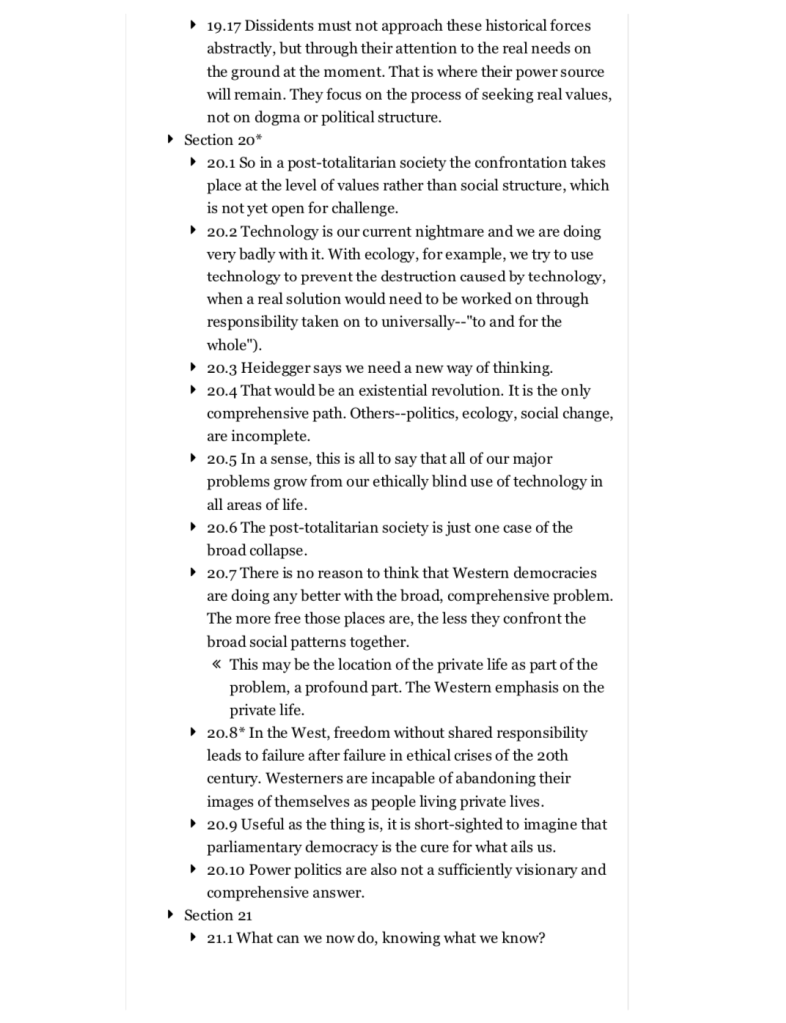
So, again, what can we do now, Havel asks, as so many have been asking today. Section 21. The answer, if we can manage one at all, lies far beyond the installation of classical parliamentary democracy. Organize, yes, but at a much more fundamental, interpersonal, ethical level, based on the demands of individual and community experience and allegiance. Look at the local clues, make our own judgments, and build upward and outward from there. See also the recent David Brooks column on Scandinavia.


 Semaphore & Cairn